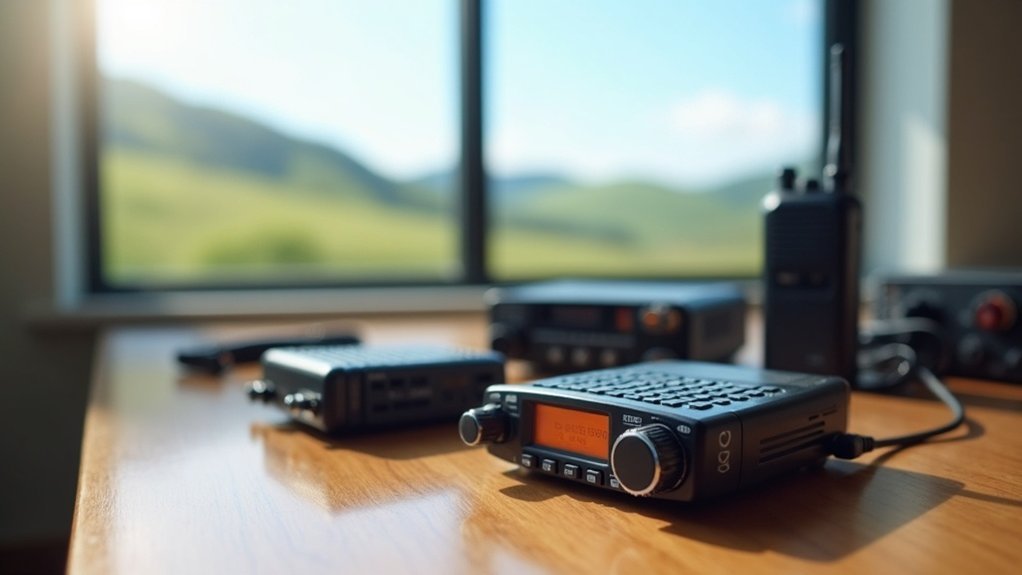
For direct communication without repeaters in survival situations, consider VHF and UHF handheld radios such as the Yaesu FT-60R, Icom IC-UV82, and Kenwood TH-D74A. These radios are ideal for simplex operations, allowing for reliable long-distance communication which can be crucial in emergency scenarios. Keep in mind that factors like line-of-sight and antenna height can significantly affect your range, so optimizing your setup is essential for effective communication. To further enhance your preparedness, explore techniques and strategies for maximizing your radio’s performance for long-distance contacts during critical times.
Key Takeaways
- VHF and UHF handheld radios are essential tools for survivalists, allowing effective direct communication over short distances without the need for repeaters.
- Reliable models such as the Yaesu FT-60R and Icom IC-UV82 are ideal for simplex operations, ensuring you can stay connected in emergencies.
- Maximizing range relies heavily on line-of-sight; positioning yourself at higher elevations can significantly enhance communication capabilities without repeaters.
- The quality and placement of your antenna are critical factors that can greatly affect the performance of radios in direct communication scenarios.
- Experimenting with different frequencies and environmental conditions is vital to determine the best setup for effective communication during survival situations.
Understanding VHF and UHF Frequencies
Understanding VHF and UHF frequencies is crucial for effective communication in survival situations and prepping scenarios. VHF, which ranges from 30 MHz to 300 MHz, offers longer wavelengths that allow signals to travel further, making it ideal for long-distance communication in open areas, such as during outdoor expeditions or emergency evacuations.
Understanding VHF frequencies is essential for long-distance communication during outdoor emergencies and expeditions.
In contrast, UHF, spanning from 300 MHz to 3 GHz, is particularly useful in urban environments due to its superior ability to penetrate structures, making it valuable for coordinating activities in populated areas during crises.
However, both VHF and UHF require line-of-sight for optimal performance; obstacles like buildings and terrain can impede signal propagation. Therefore, understanding the terrain and positioning of antennas is critical in survival situations.
Additionally, factors such as antenna height and atmospheric conditions can significantly impact the effective range of your handheld radios, which are essential tools for maintaining communication with your group during emergencies.
The Importance of Line-of-Sight
When utilizing VHF and UHF radios for survival communication, maintaining a clear line-of-sight is crucial for ensuring dependable signal strength and clarity.
Physical obstacles such as hills, buildings, and trees can significantly disrupt your signal, which is particularly important in survival situations.
Experienced operators have found that positioning the transmitting station at a higher elevation enhances range, allowing for unobstructed paths to receiving stations.
In emergency scenarios, achieving long-distance communication is possible if both stations are elevated or if one uses a mobile setup.
However, it’s important to remember that effective communication over distances exceeding 100 miles still relies on ideal conditions, such as clear weather, which may not always be available during a crisis.
Factors Influencing Radio Range
Effective communication with VHF and UHF radios is crucial for survivalists and preppers, especially in emergency situations. Understanding the factors that influence radio range can significantly enhance your ability to stay connected:
1. Terrain: Natural obstacles, such as hills and mountains, can obstruct signals, reducing effective communication range.
Planning your location with terrain in mind is essential for successful communication.
2. Altitude: Operating from higher elevations can improve signal range by minimizing obstructions and enhancing line-of-sight.
When scouting potential communication points, consider elevation as a strategic advantage.
3. Line-of-sight: Maintaining clear paths between transmitting and receiving stations is vital for optimal performance.
In survival scenarios, ensuring unobstructed views can make a critical difference in your ability to relay information.
4. Urban areas: In built-up environments, structural interference can limit radio range.
This is especially relevant for preppers who may operate in or near cities. Utilizing repeaters can help overcome these challenges and expand your communication capabilities.
Optimal Conditions for Long-Distance Communication
To maximize your long-distance communication with handheld radios in survival situations, it’s crucial to consider the terrain and ensure a clear line-of-sight.
Hills, mountains, and other obstacles can significantly limit your range, so positioning yourself at a higher elevation can be vital.
Additionally, be mindful of atmospheric conditions, such as tropospheric ducting, which can unexpectedly enhance your signal reach.
Always stay aware of your surroundings to optimize your communication capabilities in any prepping scenario.
Terrain’s Impact on Range
Although terrain significantly impacts radio communication, understanding its influence is essential for survivalists and preppers aiming to maintain effective communication over long distances. Here are some critical terrain factors to consider:
- Elevation: Operating from higher ground can be crucial in survival situations, as it reduces obstacles and improves signal range, allowing for better communication with team members.
- Obstacles: Natural features like hills and mountains can obstruct signals, which may hinder communication during critical moments when situational awareness is paramount.
- Urban Areas: In built-up regions, interference from structures can complicate communication. Having repeaters or alternative communication methods can be vital for effective range in these environments.
- Atmospheric Conditions: Understanding phenomena like tropospheric ducting can be beneficial, as they can unexpectedly extend communication distances, which may be crucial in emergency scenarios.
Importance of Line-of-Sight
Understanding the critical role of line-of-sight is vital for enhancing your radio communication abilities in survival situations. VHF and UHF signals depend on a direct pathway between transmitting and receiving stations.
Natural and man-made obstacles such as hills, buildings, and mountains can obstruct your signal, making elevated locations prime spots for long-distance communication. In optimal conditions, where you have a clear line-of-sight, your handheld radio could reach beyond 100 miles.
However, stock antennas might restrict this range, so investing in superior antenna setups is a wise strategy to significantly improve your communication capabilities.
Always prioritize maintaining a clear line-of-sight to ensure dependable connections and fully realize the potential of your radio equipment during emergencies or when preparing for uncertain situations.
Atmospheric Conditions Effects
Atmospheric conditions can significantly impact your ability to communicate over long distances with radios, an essential skill for survivalists and preppers. Here are key factors to consider:
- Temperature Inversions: These can create tropospheric ducting, allowing signals to travel hundreds of miles, which is crucial for emergency communication or coordinating with others during a crisis.
- Altitude: Higher elevations reduce obstacles and improve VHF and UHF line-of-sight propagation, making it easier to maintain contact in rugged terrain.
- Terrain: Hills and mountains can obstruct signals. It’s wise to seek higher ground for effective communication, especially when you need to relay important information quickly.
- Seasonal Effects: Summer conditions often reflect signals off the troposphere, significantly extending the range of handheld radios, which can be invaluable during outdoor expeditions or in survival scenarios.
To maximize your communication capabilities in any survival situation, ensure you have a proper antenna setup and high-quality equipment, especially in challenging environments where reliable communication may be critical.
Types of Handheld Radios Suitable for Direct Communication
Handheld radios designed for direct communication are vital tools for survivalists and preppers seeking reliable connectivity without reliance on repeaters. VHF and UHF models, such as the Yaesu FT-60R, Icom IC-UV82, and Kenwood TH-D74A, excel in simplex operations, offering ranges that can vary from a few miles to up to 100 miles depending on environmental conditions.
Factors influencing this range include terrain, antenna quality, and elevation, with higher altitudes enhancing line-of-sight communication capabilities. Techniques like tropospheric ducting can further extend your communication range.
Terrain, antenna quality, and elevation play crucial roles in radio range, with higher altitudes improving line-of-sight communication.
Additionally, using external antennas or signal boosters can significantly improve transmission strength and reception quality, allowing you to effectively connect with distant stations during emergencies or in off-grid situations.
These radios are essential for maintaining communication within your preparedness community and ensuring safety during uncertain times.
Utilizing Stock Antennas Effectively
To maximize the effectiveness of your stock antenna in survival situations, focus on strategic placement and signal reception techniques that are crucial for effective communication.
Position your radio at higher elevations, such as on a sturdy surface or elevated location, to enhance line-of-sight communication with other survivors. Always keep the antenna fully extended and ensure the radio remains upright to maintain optimal signal strength.
Regularly test your setup in various environments—such as forests, hills, or open fields—to identify the best conditions for clear communication. This knowledge can be vital in emergencies where reliable communication could mean the difference between safety and danger.
Antenna Placement Strategies
When positioning your antenna for optimal communication in survival situations, effective placement can significantly enhance your range and reliability. Here are four strategies to maximize your stock antenna’s performance:
- Height Matters: Elevate the antenna as high as possible on your vehicle or a portable mast to improve line-of-sight, which is crucial for reliable communication in emergencies.
- Avoid Obstacles: Stay clear of physical obstructions such as buildings and trees, which can interfere with signal clarity and hinder your ability to communicate in critical situations.
- Experiment with Angles: Adjust your antenna’s orientation to discover the best reception and transmission results, as different angles can yield varying levels of effectiveness depending on your surroundings.
- Consider Terrain: Be aware of hills and valleys that may block signals. Strategically position your antenna to mitigate these natural barriers, ensuring you can maintain vital communication even in challenging environments.
Enhancing Signal Reception
While stock antennas may not offer the same performance as aftermarket options, you can significantly enhance their signal reception for survival and prepping scenarios by employing effective techniques.
Elevating your antenna can improve line-of-sight, which is crucial for receiving VHF and UHF signals—essential for reliable communication during emergencies. In urban environments, where range may be limited due to obstructions, positioning your antenna on high ground can extend your communication distances, helping you stay connected with others in your survival group.
Adjusting the angle and orientation of your antenna allows you to adapt to the diverse terrain and changing atmospheric conditions, optimizing clarity for critical communications.
Regularly testing your setup in various environments will help you understand its limitations and maximize effectiveness for simplex operations. By fine-tuning your stock antenna, you can ensure that you’re well-prepared for any situation that may arise, keeping you connected and informed when it matters most.
Testing and Experimentation for Best Performance
Testing and experimenting with handheld radios can uncover unexpected capabilities, especially in survival situations where operating without repeaters is often necessary.
To ensure optimal performance in prepping scenarios, consider these strategies:
- Antenna Experimentation: Utilize high-gain or directional antennas to significantly enhance range and clarity during critical communications.
- Elevated Locations: Conduct tests from elevated positions to improve line-of-sight and minimize physical barriers, which can be crucial in emergency situations.
- Baseline Performance: Start with stock antennas to assess your baseline performance, allowing you to make informed upgrades later on based on actual needs.
- Frequency Trials: Experiment with various frequencies under different environmental conditions, such as tropospheric ducting, to identify opportunities for long-distance communication that may arise unexpectedly.
Real-World Success Stories of Long-Distance Contacts
Successful long-distance contacts with handheld radios serve as compelling examples of effective communication strategies in survival situations. Operators have managed to reach over 100 miles under optimal conditions, leveraging factors such as altitude and terrain, which are critical in emergency scenarios. Here’s a concise overview of notable success stories that highlight the potential of these devices for preppers and survivalists:
| Distance Achieved | Conditions | Notable Factors |
|---|---|---|
| 50 miles | Line-of-sight | Effective antenna setup |
| 100 miles | High ground | Optimal signal propagation |
| 200+ miles | Tropospheric ducting | Specific atmospheric effects |
These examples challenge skepticism and demonstrate that with the right knowledge and preparation, effective communication can be maintained even in remote or disaster-stricken environments, without relying on repeaters. Understanding environmental factors is essential for maximizing range and ensuring reliable communication during critical times.