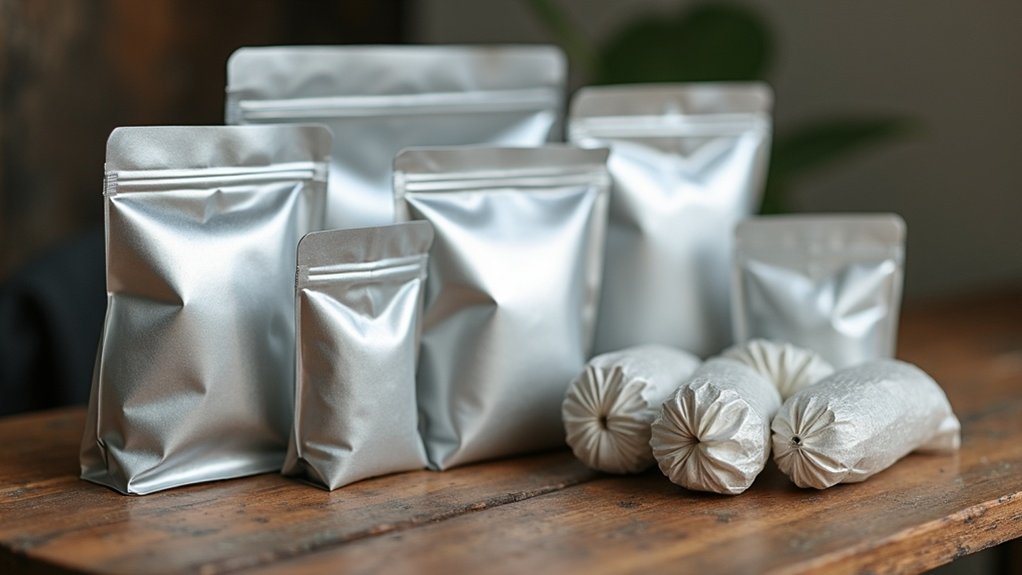
When preparing for long-term food storage in Mylar bags, selecting the right size of oxygen absorber is crucial for effective preservation. For a compact 7.5cm x 10cm pouch, a 20cc absorber is ideal. If you’re using a 10cm x 15cm bag, go with a 50cc absorber for denser survival foods, or a 100cc for lighter items. For larger 20cm x 30cm bags, a 300cc absorber is recommended. Choosing the appropriate size ensures optimal food preservation, enabling you to stockpile essential supplies for any emergency. Explore more strategies to enhance your survival storage techniques.
Key Takeaways
- A 7.5cm x 10cm Mylar bag is best paired with a single 20cc oxygen absorber to ensure effective preservation of your long-term food storage.
- For a 10cm x 15cm Mylar Ziplock bag, opt for a 50cc absorber for denser survival foods or a 100cc for lighter items, depending on your prepping needs.
- A standard 20cm x 30cm Mylar bag requires one 300cc oxygen absorber to maintain optimal storage conditions for your emergency supplies.
- Always adjust the number of absorbers based on the density of the food being stored to maximize shelf life.
- Be sure to consult size charts to determine the appropriate amount of absorbers for your specific containers and the types of food you are preparing for survival situations.
Understanding Oxygen Absorbers and Their Function
Understanding how oxygen absorbers work is vital for effective food storage in survival and prepping scenarios. These devices are designed to remove free oxygen through oxidation, utilizing iron powder that converts to iron oxide.
In sealed environments like Mylar bags, oxygen absorbers effectively eliminate oxygen, thereby extending shelf life and preserving the quality of essential food supplies. The capacity of these absorbers is measured in cubic centimeters (CC). For instance, a 300cc absorber can remove 300cc of oxygen, making it critical for long-term storage strategies.
It’s essential to match the size of the oxygen absorbers to your storage requirements, ensuring minimal residual volume while maximizing effectiveness. This way, you can have excess absorbers on hand for future needs, ready to maintain your food supplies in optimal condition.
Factors Influencing Oxygen Absorber Requirements
When selecting oxygen absorbers for your Mylar bags in the context of survivalism and prepping, it’s important to consider the type of food you’re storing.
Denser items like rice require fewer packets than lighter foods such as pasta, which is crucial for ensuring long-term food preservation.
Additionally, the size of your storage container plays a significant role; larger containers trap more air, necessitating additional absorbers to effectively safeguard your supplies.
For optimal protection of your food reserves, consult a size chart that correlates the quantity of absorbers with both the food type and container dimensions.
This will help ensure your preparedness efforts are effective and your food remains viable for extended periods.
Food Type Impact
The type of food you’re storing plays a crucial role in determining how many oxygen absorber packets you’ll need for effective preservation in your survival pantry.
Dense foods like flour and rice require fewer packets because they trap less air and oxygen between particles, making them easier to store long-term.
In contrast, less dense foods such as pasta and beans hold more air, necessitating a greater amount of oxygen absorbers to protect against spoilage and pests.
Your choice of food directly influences the quantity of oxygen absorbers needed for optimal preservation.
For best results, consult a comprehensive size chart to determine the appropriate number of packets for your specific food types.
Container Size Considerations
When selecting the appropriate number of oxygen absorbers for your food storage, it’s crucial to consider the size of your storage container. This factor greatly influences the effectiveness of preservation during long-term storage, which is vital for survival preparedness. Larger containers, such as a 6-gallon bucket, will necessitate more absorbers compared to smaller ones. Additionally, the density and type of food stored can affect the amount of air trapped within the container. To assist you in making the right choice, here’s a straightforward reference table:
| Container Size | Recommended Absorbers |
|---|---|
| 1-Gallon | 1 |
| 2-Gallon | 2 |
| 5-Gallon | 4 |
| 6-Gallon | 5 |
Keep in mind that adjustments may be required based on your local atmospheric conditions. Ensuring the proper usage of oxygen absorbers will enhance your food preservation efforts, contributing to your overall preparedness strategy.
Absorber Quantity Guidelines
Understanding the specific requirements for oxygen absorbers in food storage is crucial for maximizing the shelf life of your survival supplies.
The quantity needed varies depending on the size of the Mylar bag and the type of food being stored. For a 1-gallon Mylar bag, it’s recommended to use 1-2 oxygen absorbers rated at 300cc.
For a 2-gallon bag, you may need either 2 absorbers rated at 500cc or 1 absorber rated at 1000cc. A 5-gallon Mylar bag typically requires 1-2 absorbers rated at 2000cc or 2-3 absorbers rated at 1000cc.
Be sure to adjust your quantities based on trapped air and specific storage conditions. Using excess absorbers isn’t a concern, as they’ll simply remain inactive.
Refer to a size chart to assist you in selecting the optimal quantity for your prepping needs.
Recommended Oxygen Absorber Sizes for Mylar Bags
When choosing oxygen absorbers for Mylar bags in the context of survivalism and prepping, it’s essential to consider both the size of the bag and the type of food you’re preserving for long-term storage.
For example, a 7.5cm x 10cm Mylar pouch is best paired with a 20cc absorber, while a 20cm x 30cm bag—regardless of its heavy-duty construction—requires a 300cc absorber to effectively maintain an anaerobic environment.
Keep in mind that these recommendations serve as general guidelines, and you may need to adjust based on the specific air volume within your bags to ensure optimal preservation of your food supplies.
Mylar Bag Size Guidelines
Selecting the correct oxygen absorber size for your Mylar bags is crucial for effective food storage and preservation, especially for survivalists and preppers.
For a 7.5cm x 10cm Mylar pouch, use 1 x 20cc oxygen absorber to help keep your food fresh.
If you’re using a 10cm x 15cm Mylar Ziplock bag, opt for 1 x 50cc for denser foods and 1 x 100cc for less dense options.
A standard 20cm x 30cm Mylar bag requires 1 x 300cc oxygen absorber, suitable for both regular and heavy-duty bags.
Remember, adjustments may be necessary based on the total volume of air in the bags, as these recommendations are averages.
Properly sizing your oxygen absorbers is key to ensuring your food supplies remain viable for long-term storage and emergency preparedness.
Food Type Considerations
Choosing the right oxygen absorber size is crucial for effective food storage in survival and prepping scenarios. It’s not just about the bag dimensions; the type of food you’re storing plays a significant role.
For small, dense food items like nuts, a Mylar pouch (7.5cm x 10cm) requires a 20cc oxygen absorber to ensure long-term preservation. When storing denser foods, such as rice, opt for a 50cc absorber in a Mylar Ziplock bag (10cm x 15cm) to maintain freshness.
For less dense items like pasta, a 100cc absorber is ideal. If you’re using a larger Mylar bag (20cm x 30cm), a 300cc oxygen absorber will effectively handle various food types.
Oxygen Absorber Capacities
Understanding oxygen absorber capacities is crucial for effective food preservation, especially in the context of survivalism and prepping.
For a Mylar pouch measuring 7.5cm x 10cm, a single 20cc oxygen absorber is adequate for all food types, making it a practical choice for long-term storage.
If you opt for a Mylar Ziplock bag (10cm x 15cm), it’s advisable to use 1 x 50cc absorber for denser foods or 1 x 100cc for less dense options to ensure optimal preservation.
For a standard Mylar bag (20cm x 30cm), using 1 x 300cc absorber will work well across all food types, including heavy-duty bags that also require the same 300cc amount.
Keep in mind that adjustments might be necessary based on specific food types and air volume to achieve the best results for your preparedness needs.
Assessing Food Type and Density for Storage Needs
When evaluating food type and density for storage needs in the context of survivalism and prepping, it’s crucial to recognize how these factors impact the amount of air and oxygen trapped within Mylar bags.
Dense foods like rice and flour require fewer oxygen absorbers compared to less dense foods such as pasta and beans, which trap more air and can lead to spoilage.
- Assess the density of your food for optimal oxygen absorption to enhance shelf life.
- Consult the size chart for recommended oxygen absorber quantities to ensure effective preservation.
- Adjust your storage strategy based on local atmospheric conditions to maximize food longevity.
Container Size and Its Impact on Oxygen Absorber Usage
When developing your food storage strategy for survival situations, the size of your container is crucial in maximizing the effectiveness of oxygen absorbers. For instance, larger containers like a 6-gallon bucket will necessitate more oxygen absorber packets compared to smaller containers like a 1-gallon bucket. This is primarily due to the larger volume of air and food that needs to be protected.
When using Mylar bags for long-term food storage, the recommended amount of oxygen absorbers also varies with the size of the bag; typically, you’ll need about 300-500cc of oxygen absorber for each gallon of food stored.
Always take into account both the container size and the type of food you’re storing to accurately determine your oxygen absorber requirements for optimal preservation in your prepping efforts.
Adjusting Oxygen Absorber Quantities Based on Conditions
To ensure your food storage is optimal for survival situations, it’s crucial to adjust the quantity of oxygen absorbers based on specific conditions.
Keep the following factors in mind:
- The volume of air in your container—larger containers require more absorbers to effectively minimize oxygen levels.
- Humidity levels in your environment, as higher humidity can hinder oxygen absorption and may necessitate additional absorbers.
- The type of food stored; denser foods like grains usually require fewer absorbers compared to lighter items like pasta, which may need more.
A guideline of 300-500cc of absorbers per gallon is a good starting point, but be sure to adapt it according to your unique circumstances.
While overpacking absorbers is generally safe, as excess absorbers will remain inactive, it’s important to ensure that your food’s quality isn’t compromised.
Proper preparation is key to ensuring long-term food storage success in any survival scenario.
Best Practices for Using Oxygen Absorbers With Mylar Bags
Using oxygen absorbers effectively with Mylar bags is essential for preserving the quality and longevity of your stored survival food.
For a 7.5cm x 10cm Mylar pouch, include one 20cc oxygen absorber to create an optimal seal.
For optimal sealing, use one 20cc oxygen absorber in a 7.5cm x 10cm Mylar pouch.
In a 10cm x 15cm Mylar ziplock bag, choose a 50cc absorber for denser foods, or a 100cc for lighter options, ensuring your provisions remain viable in emergency situations.
For standard and heavy-duty 20cm x 30cm Mylar bags, a single 300cc oxygen absorber is sufficient.
Always consider the air volume within the bag and adjust the number of absorbers accordingly.
Keep in mind that while excess absorbers won’t compromise food quality, they can help ensure ideal storage conditions for your prepper supplies.