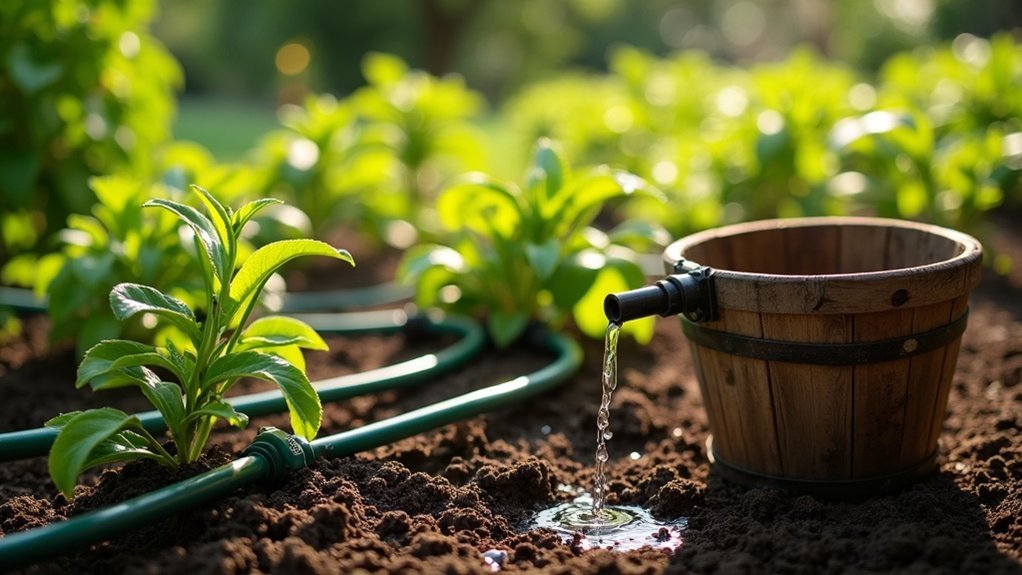
To set up a power-free drip irrigation system suitable for survival and prepping, begin with a 15 mm poly pipe as your main line. Cut the pipe to fit your garden layout, ensuring it accommodates your self-sufficient lifestyle. Attach T connectors to create drip lines that will efficiently water your crops. Connect your main line to a water source, using a reducer to manage flow and conserve water—an essential resource in survival situations. Create small holes in the drip lines for precise watering, which minimizes waste and maximizes efficiency. Regularly monitor pressure and adjust settings as needed to cater to the specific needs of your crops. For further insights on optimizing your irrigation system for self-reliance, consider additional resources and tips tailored for prepping.
Key Takeaways
- Utilize a reliable water source, such as a garden tap or rainwater collection system, to supply your drip irrigation setup, ensuring sustainability in times of crisis.
- Establish a 15 mm poly pipe as the main line, allowing for adaptability to your garden’s unique layout and needs.
- Incorporate T connectors to effectively distribute water from the main line to individual drip lines, providing focused irrigation where it’s needed most.
- Control water flow by adjusting the tap linked to the main line, enabling efficient distribution without reliance on electricity, which is crucial during power outages.
- Consistently inspect the system for clogs or leaks, and make necessary adjustments to maintain optimal performance and ensure your garden thrives even in challenging circumstances.
Understanding Drip Irrigation Basics
Understanding the fundamentals of drip irrigation is crucial for efficient water management in a survival garden. This irrigation system delivers water directly to plant roots through a network of tubing and emitters, minimizing evaporation and runoff—key factors when resources are limited.
Your basic setup includes a main line made from 15 mm poly pipe, which can be tailored to fit your survival garden layout. Water flow is controlled by adjusting the tap connected to the main line, allowing for precise delivery during times of scarcity.
Regular monitoring and slight adjustments are necessary to prevent issues like excessive spillage or inadequate watering, ensuring that your plants receive just the right amount of moisture to thrive even in challenging situations.
Materials Needed for Your Setup
To establish a reliable drip irrigation system that aligns with survivalism and prepping principles, you’ll need specific materials to ensure effective water delivery to your plants, especially in situations where resources are limited.
Start with a 15 mm poly pipe for the main line, which can be cut to fit your garden layout while allowing for flexibility in various planting scenarios. Essential connectors, such as T connectors, will aid in customizing your irrigation setup for different planting beds, ensuring that all areas receive adequate water.
A dependable water source, such as a garden tap or even a rainwater collection system, must connect to the irrigation system. Implement a water reducer to manage the flow to the drip lines effectively, conserving water and prolonging your supply.
Use pipe clamps or black tape to seal any larger holes, which will help you maintain control over water flow and prevent wastage. Additionally, incorporating packing materials can assist in adjusting water pressure, ensuring your system operates efficiently without relying on electricity—an important consideration for any survivalist or prepper.
Step-by-Step Assembly Process
To assemble your drip irrigation system effectively in a survival or prepping scenario, first gather all your materials and tools.
This setup will ensure you have a reliable water source for your crops in any situation.
Follow these steps for a successful installation:
- Cut a 15 mm poly pipe to fit your main line and drip lines, ensuring it can withstand various weather conditions.
- Use T connectors to securely join the main line to the drip lines, creating a robust network for water distribution.
- Attach the main line to a water source, using a water reducer to manage flow and conserve resources.
- Create small holes in the drip line for controlled water distribution, optimizing water usage for your plants.
- Regularly monitor and adjust the system, especially after crop rotations, to maintain efficiency and adapt to changing conditions.
This setup will provide you with a sustainable irrigation solution for your survival garden.
Managing Water Flow and Distribution
Effective management of water flow and distribution is crucial for optimizing your survival garden’s irrigation system. You can control water flow by using a tap that adjusts pressure, catering to the needs of various crops that may be essential for self-sufficiency.
By cutting the mainline, typically a 15 mm poly pipe, you gain flexibility in water distribution for different planting bed sizes, which is vital during times of uncertainty. Connect drip lines with basic T connectors for easy assembly and reconfiguration, making it adaptable for changing needs.
Verify holes in the drip line are properly sized to prevent excessive spillage, ensuring every drop counts in a survival situation. Regularly adjust water flow and pressure at the tap to accommodate crop rotation and seasonal watering variations, helping to maximize your yield and sustain your food supply.
Tips for Maintenance and Adjustments
Maintaining your drip irrigation system is crucial for ensuring its efficiency and longevity, especially in a survivalist or prepping context. Here are some essential tips to keep your system in optimal condition:
- Regularly inspect for clogs or leaks to prevent water loss, which is vital for self-sufficiency during emergencies.
- Adjust tap settings to manage pressure and avoid over-saturation, particularly during heavy rainfall, to ensure your water supply remains reliable.
- Make seasonal adjustments to align with crop rotation and changing water needs, so you can maximize food production.
- Monitor soil health and moisture levels to properly calibrate your setup, ensuring your crops are nourished without waste.
- Use packing materials or tape to seal larger holes in the drip lines, controlling flow rates effectively to maintain your water resources.